
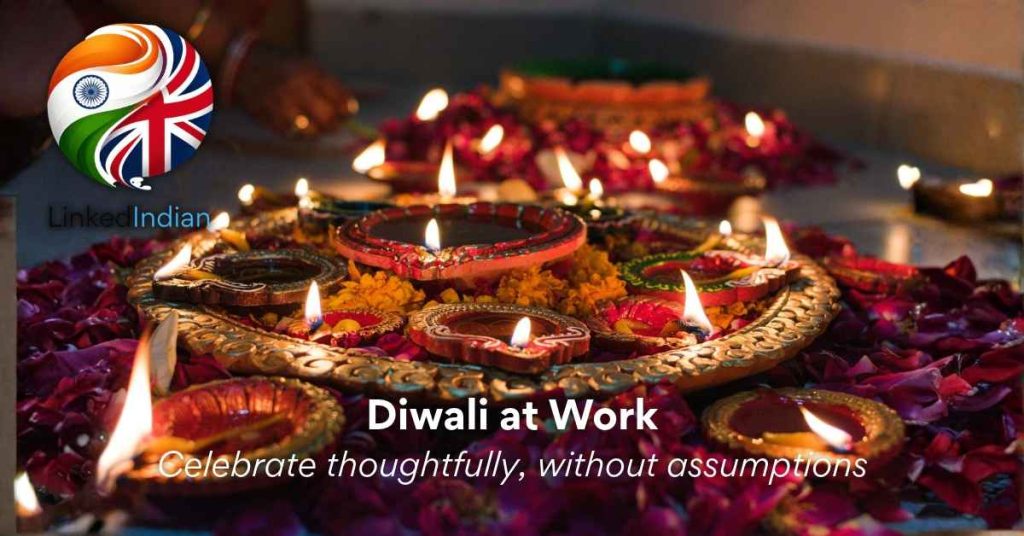
Planning Diwali at work in the UK can be meaningful, but there is no single way to observe the festival. If you are organising a team activity, asking for time off or deciding how to acknowledge the festival, the most useful starting point is curiosity without expectation. You can recognise Diwali warmly without asking one colleague to speak for every Indian, Hindu, Sikh, Jain or South Asian person in the room.
This guide offers practical ways to make a workplace celebration more thoughtful. It is for managers, colleagues and people who would like to mark the festival at work while leaving room for different beliefs, family traditions and personal preferences.
What to know about Diwali at work in the UK
Diwali, also known as Deepawali, is a five-day festival observed by Hindus, Jains, Sikhs and some Buddhists. The date changes each year, and customs vary between communities and families. Royal Museums Greenwich notes that the festival is celebrated in different ways around the world.1
That diversity matters at work. Some people may attend prayers, visit relatives or take part in family traditions. Others may celebrate in a less religious way, may not observe Diwali at all, or may prefer to keep their faith and cultural life private. An Indian colleague is not automatically a Diwali spokesperson, event organiser or representative of a whole community.
If you are publishing this guide in 2026, note that the main date fell on Sunday 8 November. Check a reliable calendar each year before adding a date to an event invitation or social post.1
If you are a manager or event organiser
Ask before planning on someone else’s behalf
A brief, open question is more useful than an assumption. You might say: “We are thinking about how to acknowledge Diwali at work. Would you welcome an optional activity, or would you prefer that we keep it low-key?” Make clear that the person does not have to answer, plan the event or explain their beliefs.
If colleagues volunteer to help, agree what they want to contribute and give them time and resources. Do not make participation part of someone’s performance expectations. A person who celebrates the festival may still not want to organise a work event.
Handle leave requests fairly
Some employees may want time off for a religious festival or related family commitments. ACAS recommends that employers try to accommodate requests where possible and handle them fairly. It also says there is no general legal requirement to grant time off for religious reasons, although an unreasonable refusal could be discriminatory.2
The practical approach is to use the same transparent process you use for other leave requests. Encourage advance notice when that is realistic, consider staffing needs, and explain how you will deal with competing requests. Avoid informal rules that favour one faith or make employees feel they need to disclose more than necessary.
A useful response could be: “Thanks for letting me know. Please submit the dates through the usual leave process, and I will review the request consistently with the team rota.” If a request cannot be granted as asked, discuss alternatives such as a different shift, a shorter day or another date. For a difficult case, seek appropriate HR or legal advice rather than relying on general guidance alone.
Keep celebrations optional and welcoming
An activity can be meaningful without being compulsory. If you arrange a shared meal, a short talk or a craft activity, explain that joining is optional. Do not use a public round-robin that asks everyone to describe their religion or family customs. Make it easy to observe quietly or not participate.
Where possible, invite volunteers from different backgrounds to shape a broader calendar of cultural and faith events. That helps avoid placing the burden of inclusion on one employee or treating a single festival as the only occasion worth recognising.
Think about food, timing and accessibility
Ask about dietary needs when planning food, and label dishes clearly. Do not assume every vegetarian dish is suitable for everyone, or that colleagues who do not eat a particular food want to explain why. Include non-food options so people can take part without needing to eat.
Consider shift patterns, caring responsibilities, prayer needs and accessibility. A celebration scheduled at short notice, after a long shift or in a space that some colleagues cannot access may unintentionally exclude people. Small adjustments to the time, format or location can make a real difference.
Avoid putting colleagues on the spot
Do not ask one person to perform a ritual, wear particular clothes, bring food from home or explain a belief unless they have freely offered. Avoid questions such as “What do Indians do for Diwali?” A better question is: “Would you like to share anything about how you mark the occasion, or would you rather not?”
ACAS advises employers to promote understanding while ensuring that people do not feel excluded because of religion or belief.2 That is a workplace responsibility, not a task to delegate to employees from a particular background.
If you want to raise Diwali with your manager
You can keep a request simple and specific. For example:
“I would like to request annual leave on [date] for Diwali. I can give notice now and am happy to discuss how my work can be covered.”
If you would welcome a small workplace acknowledgement, you might add:
“If the team is planning anything, I would be happy to share an idea, but I cannot take responsibility for organising the whole event.”
You do not need to disclose personal religious details beyond what is necessary for the request. If you are unsure how a request will be handled, check your employer’s leave policy or speak to HR or a staff network.
If you are invited to share your experience
Decide what you are comfortable sharing. You might offer a short personal reflection, recommend a song or recipe, suggest a charity, or simply say you would prefer not to participate. You do not need to give a religious explanation or answer questions on behalf of a whole community. For example: “I’m happy to share what Diwali means to my family, but it may be different for others.” That keeps the conversation personal and makes room for variation. Colleagues should accept a “no” without asking for a reason.
A quick planning checklist
Before announcing a workplace Diwali activity, check that you have:
- Asked whether an activity is wanted rather than assuming.
- Made participation genuinely optional.
- Shared the date and purpose clearly, with enough notice.
- Considered shift patterns, accessibility and dietary needs.
- Avoided asking one colleague to speak for a whole community.
- Used a fair, consistent process for time-off requests.
- Included colleagues who do not celebrate, without pressuring them to take part.
A respectful celebration leaves room for difference
The best workplace acknowledgement is not necessarily the biggest. A thoughtful message, fair leave process or optional shared activity can recognise the festival without turning colleagues into representatives. If you are leading the effort, ask, listen and make participation easy to decline.
For more on everyday communication and expectations, read LinkedIndian’s guide to UK workplace culture. For current legal or employment concerns, seek advice from a qualified professional or an appropriate employment-advice service.