
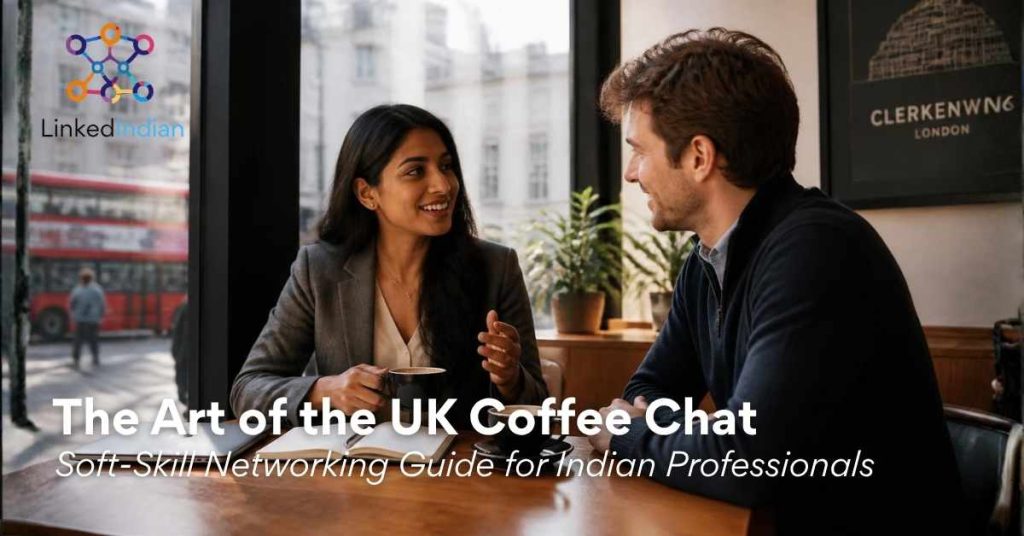
Mastering the UK coffee chat is a critical professional competency for Indian professionals transitioning to the United Kingdom. While many are recognized for their technical brilliance, they often encounter a significant barrier: the informal networking culture of the UK. This culture, epitomized by the “coffee chat” or the “after-work pub visit,” can feel confusing or even intimidating. However, these informal interactions unlock the “hidden job market” in the UK. Therefore, understanding how to navigate these social spaces is essential for career success.
“Networking in the UK is less about ‘what you know’ and more about ‘how you fit.’ The UK coffee chat is the primary vehicle for assessing that fit before a formal interview begins.”
Understanding UK Coffee Chat Culture
To navigate the UK networking scene, you must first understand the cultural differences in professional communication. In India, professional respect often involves a clear acknowledgment of hierarchy. Communication tends to be direct regarding tasks but formal regarding social boundaries. Conversely, the UK professional environment is more egalitarian and indirect. British politeness dictates that “business” follows a layer of social rapport. Consequently, “informal” settings are where the most important professional decisions are seeded.
The UK coffee chat is a perfect example of this cultural divergence. In the United Kingdom, a coffee chat is defined as an informal informational interview 1. It is not a request for a job. Instead, it is a request for perspective, advice, and connection. For many Indian professionals, asking for a meeting without a specific “transactional” goal can feel awkward. However, in the British context, the relationship is the transaction. Building rapport is an essential prerequisite for professional trust. This shift from a “task-first” to a “relationship-first” approach is the cornerstone of a successful UK coffee chat.
The Reality of the ‘Hidden Job Market’
One compelling reason to master the UK coffee chat is the existence of the hidden job market. Research suggests that a significant portion of professional roles in the UK—estimated as high as 70% to 80%—are never advertised on public job boards 2. Instead, internal referrals and professional networks fill these positions. These connections are often forged during informal interactions.
By engaging in soft-skill networking, you position yourself within this ecosystem. When a role becomes available, a manager is more likely to remember a professional from an insightful UK coffee chat than a nameless CV. Therefore, you should view these meetings as a long-term investment in your career visibility. This proactive engagement demonstrates a level of initiative and cultural awareness that UK employers highly prize.
LinkedIn: The Digital Gateway to Your UK Coffee Chat
In the UK, LinkedIn is the primary platform for bridging the gap between a cold contact and a warm UK coffee chat. However, many Indian professionals use the platform as a digital repository for their CV rather than a dynamic networking tool. To successfully transition, you must shift to active, soft-skill engagement.
This process begins with personalized connection requests. In the UK, sending a blank connection request to a senior professional can be perceived as impersonal. Instead, include a brief note explaining why you wish to connect. For example, mention an article they shared or a recent company project you admire. Furthermore, engage with their content through thoughtful comments. This “pre-networking” ensures that when you eventually request a UK coffee chat, you are a recognized name in their notifications.
The Etiquette of a UK Coffee Chat Request
Once you establish a connection, the goal is to secure twenty to thirty minutes of their time. You must avoid appearing entitled or overly aggressive. A common mistake is sending a long, detailed CV and asking for a job referral in the first message. In the UK, this is “too much, too soon.” Instead, focus your outreach on genuine curiosity about their career path or a specific project.
When drafting your request, emphasize that you are seeking insights rather than employment. Use phrases like “I would value your perspective on…” or “I am keen to learn about your journey into…” This aligns with the British preference for indirectness and humility. Furthermore, always offer to work around their schedule. Suggest a specific, concise timeframe. A request for a “quick 20-minute UK coffee chat” is much more likely to be accepted than a vague “meet up” request. It respects their time and sets clear boundaries 3.
Engaging with Headhunters and Recruiters
Headhunters and recruiters are a significant part of the UK job market. While these interactions are often more direct, they still benefit from a soft-skill approach. Treat initial conversations as opportunities to learn about market trends, not just to push your CV.
When a headhunter reaches out, respond promptly and professionally. Even if the role isn’t a perfect fit, express gratitude for their consideration. Ask insightful questions about the market or their client’s needs. This positions you as a thoughtful professional. A positive interaction can lead to future opportunities, even without an immediate job offer. Recruiters remember candidates who are easy to work with and demonstrate strong communication skills.
The Rise of the Virtual UK Coffee Chat
The pandemic accelerated the adoption of virtual meetings. Consequently, the virtual UK coffee chat is now a permanent fixture in professional networking. While the setting changes, the core principles remain the same. You must still build rapport, seek insights, and demonstrate soft skills. However, virtual interactions introduce new etiquette requirements.
Preparation is key for a virtual UK coffee chat. First, ensure your technology works by testing your camera and microphone. Second, choose a quiet, professional background and dress appropriately. During the call, maintain eye contact with your camera to simulate direct engagement. Be mindful of your body language; subtle nods and attentive posture convey interest.
Active listening is even more critical in a virtual setting. Without the full range of non-verbal cues, verbal affirmations like “I see” or “That’s interesting” help assure the speaker you are engaged. Avoid multitasking and give your full attention. Finally, follow up promptly with a thank-you email. Reference specific points discussed to show you were listening.
The Anatomy of a Successful UK Coffee Chat
Once the meeting is secured, the challenge shifts to the interaction. Indian professionals often feel the urge to immediately demonstrate technical prowess. However, a UK coffee chat is as much about small talk as it is about big ideas. The first few minutes are dedicated to non-work topics. This is a crucial period where you are evaluated for soft skills and cultural compatibility.
Small talk in the UK is a sophisticated social ritual. It revolves around neutral topics like the weather, the commute, or the environment. These subjects serve as social lubricants that signal friendliness. Therefore, it is vital to avoid intrusive personal questions—such as salary, marital status, or age. These are considered highly inappropriate in a UK professional context 4. Instead, focus on shared professional experiences or light-hearted observations.
| Feature | Indian Networking Style | UK Networking Style |
|---|---|---|
| Primary Focus | Technical Merit & Credentials | Cultural Fit & Rapport |
| Communication | Formal & Hierarchical | Informal & Egalitarian |
| Setting | Office or Formal Meetings | Coffee Shops, Pubs, or Cafes |
| Request Style | Transactional (Job/Referral) | Relational (Advice/Insights) |
| Small Talk | Brief or Personal/Family-oriented | Extended & Neutral (Weather/Commute) |
Navigating the Pub Culture
The “after-work drink” in a British pub is a central professional institution. It is a place where hierarchies flatten and honest conversations occur. For Indian professionals who do not drink alcohol, this can feel exclusionary. However, “going to the pub” is about social presence, not alcohol consumption.
It is perfectly acceptable to order a soft drink or non-alcoholic beer. The key is participating in the dialogue. A crucial nuance is the “round system.” If the group is buying rounds, offering to buy one—even for soft drinks—demonstrates you are a “team player.” Avoiding these visits entirely can inadvertently signal a lack of interest in the team’s social fabric. Consequently, this may impact your long-term career growth.
The Power of Indirectness and “Softening”
British professional language is famously indirect. For instance, if a colleague says, “That’s an interesting idea,” they might actually mean “I don’t think that will work.” Understanding these nuances is vital during a UK coffee chat. Indian professionals, accustomed to more direct feedback, can sometimes miss subtle cues of disagreement or hesitation.
To mirror this style, practice “softening” your language. Instead of saying “You are wrong about X,” try “I see your point, though I wonder if we might also consider Y.” This approach preserves rapport while allowing for a professional exchange. This soft-skill mastery is what distinguishes a technically brilliant candidate from one perceived as a “great addition to the team.”
The Follow-Up: Cementing the Connection
The networking process does not end when you leave the cafe. The follow-up is where you solidify the relationship. Within twenty-four hours, send a brief, personalized note thanking the individual for their time. Reference a specific piece of advice they gave or a topic you discussed. This shows that you were actively listening.
“A follow-up is not just a thank you; it is a bridge to the next conversation. It transforms a one-off meeting into a professional relationship.”
If they suggested a resource, make sure to read it and mention it in your follow-up. This demonstrates initiative and respect for their expertise. For instance, if you discussed the UK job market, you might reference the existing LinkedIndian guide on Crafting a UK Ready CV: Key Differences from an Indian Resume. This provides a foundational understanding of how to present your skills to a British audience.
Validating Your Networking Strategy
To ensure your efforts align with best practices, consult external resources. The British Council’s guide on professional networking offers insights into UK social cues. Additionally, the University of Oxford’s Careers Service provides structured advice on building sustainable professional networks.
Conclusion: Mastering the UK Coffee Chat
For the Indian professional in the UK, transitioning to a soft-skill networking approach is a vital cultural adaptation. It requires stepping outside the comfort zone of formal structures to embrace the ambiguity of the informal chat. By mastering the UK coffee chat, navigating the social nuances of the pub, and refining the subtle language of British politeness, you can bridge the gap between technical brilliance and professional success. In the UK, your next career breakthrough is just as likely to start over a cup of tea as it is in a formal boardroom.
References
Prospects UK, “Informational Interviews,” 2026.
[2] Forbes, “The Hidden Job Market,” 2025.