
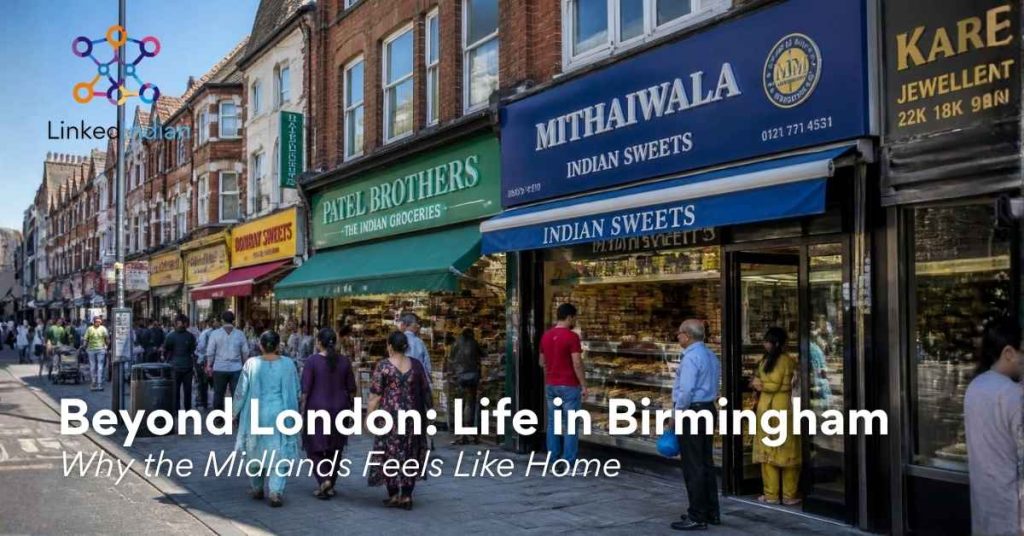
Many Indian professionals landing in the UK often look to London first. They are told it is where the action is, where careers are made, and where the “community” thrives. However, for those of us who truly know the UK’s heartbeat, another city offers something London often cannot. It provides a soul that feels like a home away from home, without the relentless, anonymous hustle.
I was born and raised in Birmingham. This city is more than just a pin on a map to me. It is a collection of memories, scents, and sounds that have shaped who I am. The Brummie accent is warm, self-deprecating, and welcoming. It mingles with the familiar cadence of Punjabi, Gujarati, and Hindi on every street corner. Here, you do not just “fit in”; you belong.
Are you an Indian professional, student, or family seeking a life that balances career ambition with cultural richness and genuine quality of life? Then it is time to look past the M25. Welcome to Birmingham, the true powerhouse of the West Midlands. This city is currently redefining what it means to be a global, multicultural hub in the 21st century.
The Cultural Heartbeat: A Walk Down Soho Road
Whenever I feel a pang of nostalgia for India, I do not book a flight. Instead, I head to Soho Road in Handsworth. Growing up in the city, a trip to Soho Road was never just a “quick errand.” It was a Saturday morning ritual, a sensory immersion that stayed with you long after you had left.
The road itself is a living, breathing tapestry of the Indian diaspora’s journey in the UK. It is a place where the past and future collide. Grand Victorian buildings now house bustling Asian grocery stores. Their windows are stacked high with Alphonso mangoes in the summer and enormous bags of Tilda basmati rice year-round.
Walking down this iconic stretch, you are greeted by the intoxicating aroma of fresh samosas. The sweet, syrupy scent of jalebis frying in massive kadhais fills the air. Have you visited the Milan Sweet Centre? If not, you have not truly experienced Birmingham. It has been a community staple for decades. Generations have gathered there to buy boxes of barfi for weddings or to enjoy chole bhature. This dish tastes exactly as if it were made in a Delhi dhaba. I remember the clatter of steel plates and the hum of conversation. Aunties debated the quality of a silk saree, while young professionals grabbed a quick, authentic lunch between meetings.
Soho Road is the “Mini India” that London’s Southall or Wembley aspire to be. It possesses a grit and authenticity uniquely Midlands. Here, saree shops do not just sell fabric; they sell heritage. The jewellers are family-run institutions. Owners know your parents and grandparents. During Diwali, the entire road transforms into a river of light. For Vaisakhi, the Nagar Kirtan procession is one of the largest and most vibrant outside of India. It is a place where you can find every spice, every herb, and every comfort from home. These are usually available at a fraction of the price you would pay in the capital.
Beyond the High Street: The Black Country Connection
While Soho Road is the spiritual home, Indian influence extends deep into the Black Country. Areas like Smethwick and West Bromwich offer a different, perhaps more grounded, perspective on Midlands life. Smethwick holds a special place in history. Malcolm X famously visited in 1965 to support the local Indian community against racial segregation. This serves as a reminder of the resilience and strength defining this region. Today, these areas are thriving residential hubs. You will find tight-knit communities and local parks filled with families. Some of the best hidden-gem pubs serve “Desi Pub” food. Imagine succulent chicken tikka and mixed grills paired with a cold pint of local ale.
“Birmingham doesn’t try to impress you with shiny skyscrapers; it wins you over with its warmth. It is the difference between a polite handshake and a genuine, bone-crushing hug from an old friend.”
Spiritual Anchors: Finding Peace in the Midlands
For the Indian community, faith and community are often intertwined. Birmingham and the surrounding Black Country host some of Europe’s most significant spiritual landmarks.
In Tividale, a short drive from the city centre, stands the Shri Venkateswara (Balaji) Temple. As Europe’s largest Hindu temple of its kind, it is a marvel of Dravidian architecture. I remember visiting as a child. I was struck by the silence and majesty of the gopurams against the often-grey Midlands sky. It is more than a place of worship. It is a community hub offering a sense of peace, hard to find in modern life’s chaos.
Then there is the Guru Nanak Nishkam Sewak Jatha on Soho Road. This Gurdwara testifies to the Sikh community’s contribution to the city. Its golden domes are a landmark. However, its real beauty lies in its commitment to sewa (selfless service). The langar (community kitchen) is always open, serving thousands of meals. This hospitality defines the Birmingham spirit, whether you are a devotee or a curious visitor.
The Culinary Revolution: From Balti to Michelin Stars
You cannot talk about Birmingham without discussing its food. This city gave the world the Balti. In the late 1970s, the “Balti Triangle”, centred around Ladypool Road and Stratford Road, became the birthplace of this unique British-Asian fusion. Eating a Balti in Birmingham is a rite of passage. It is served in the thin, pressed-steel bowl it was cooked in. It is meant to be scooped up with a “table-top” naan the size of a small rug. This was food for the people: fast, affordable, and incredibly flavourful.
The Birmingham food scene has evolved spectacularly. While street food on Soho Road remains unmatched for authenticity, the city has become a global destination for fine dining. For a deep dive into the local dining scene, explore our dedicated guide to the best Indian restaurants in Birmingham.
At the forefront of this revolution is Aktar Islam, the visionary chef behind Opheem. Opheem, located on Summer Row in the Jewellery Quarter, is the first Indian restaurant outside of London to hold two Michelin stars. Aktar’s journey, from a young boy in Aston to a world-class chef, mirrors Birmingham’s story. It is ambitious, creative, and unapologetically proud of its roots. A meal at Opheem is not just dinner. It is a masterclass in how Indian flavours can be elevated using global techniques. Imagine a traditional Aloo Tokri reimagined with a jeweller’s precision. Or a Lamb Rogan Josh that respects its heritage while fitting into any world-class gallery.
The Jewellery Quarter: Where Heritage Meets Modernity
Opheem sits in the heart of the Jewellery Quarter, one of Birmingham’s most fascinating areas. Historically, it was responsible for over 40% of the UK’s jewellery production. Today, it is a trendy residential and creative hub. For the Indian community, the connection is obvious: our love for gold and craftsmanship is legendary. The JQ, as locals call it, is where young Indian professionals now choose to live and work. It features red-brick warehouses converted into loft apartments, independent coffee shops, and hidden cocktail bars. It perfectly exemplifies how Birmingham preserves its industrial past while building a chic, modern future.
If you seek something slightly more casual yet equally refined, Lasan (also in the Jewellery Quarter) remains a powerhouse. It famously won Gordon Ramsay’s “Best Local Restaurant” title years ago. The city teems with modern Indian spots. Dishoom at Chamberlain Square pays homage to Mumbai’s Irani cafes. Asha’s has hosted everyone from Tom Cruise to the Rolling Stones. Whether you desire a £5 street food snack or a £200 tasting menu, Birmingham delivers with unmatched passion.
A Quality of Life That Makes Sense
For many Indian professionals, the “London Trap” is a real concern. High salaries are often immediately swallowed by astronomical rents and tiny, garden-less flats. Birmingham offers a different path.
Here, your money goes further. Consider the leafy suburbs of Edgbaston, the professional enclave of Solihull, or the historic charm of Sutton Coldfield. You can afford a home with a garden. This provides space to grow your own chillies, coriander, and curry leaves, just like our parents did.
Education and Opportunity
The West Midlands education system is another huge draw. This is especially true for Indian families who prioritise academic excellence. The King Edward VI Grammar Schools consistently rank among the best in the country. They provide a world-class education accessible to all, regardless of background. I have seen firsthand how these schools act as a springboard for the next generation of doctors, engineers, and entrepreneurs.
For those in higher education, the University of Birmingham (a Russell Group institution) is more than just a place of study. It is a beautiful, red-brick campus that feels like a city within a city. Aston University, located right in the city centre, also stands as a global leader in research and innovation. Both attract thousands of Indian students every year, bringing fresh energy and perspective to the city.
The Passion for Sport
And let us not forget sport. For an Indian, nothing quite compares to a match day at the Edgbaston Stadium. When India plays here, the atmosphere is electric. The “Eric Hollies Stand” becomes a sea of blue. The roar of the crowd can be heard for miles. It is one of the few places in the UK where you truly feel like the home team.
Why Birmingham is the Future
Birmingham is currently undergoing a massive transformation. The arrival of HS2, the redevelopment of the city centre (Paradise and Smithfield), and a burgeoning tech and finance sector (with major hubs for HSBC and Goldman Sachs) mean endless opportunities.
Beyond the economics, the feeling of the city stays with you. It is a place where you can be a high-flying professional during the day. In the evening, you can find a community that feels like family. It is a city that respects its past but races towards a diverse, inclusive future.
“Growing up here, I learned that you do not have to choose between being British and being Indian. Birmingham is where those two identities do not just coexist; they thrive together.”
I am proud to be a Brummie. I am proud of how this city welcomed my family. It continues to welcome thousands of others. If you are looking for your next move, do not just follow the crowd to London. Come to the heart of the country. Come to Birmingham.
We want to hear from you!
This is just the beginning of our exploration of life in the West Midlands. We are planning a series of follow-ups to help you navigate your journey here. However, we want to know what you need most.

What should we cover next?
- The School Run: A deep dive into the best grammar and independent schools in the region.
- The Property Guide: Which neighbourhoods offer the best value for Indian families?
- Hidden Gems: A food tour of the best-kept secrets in the Black Country and beyond.
- Career Spotlight: Navigating the Birmingham tech and finance job market.
Drop a comment below and let us know your choice, or share your favourite Birmingham memory. Let us build this community together!