
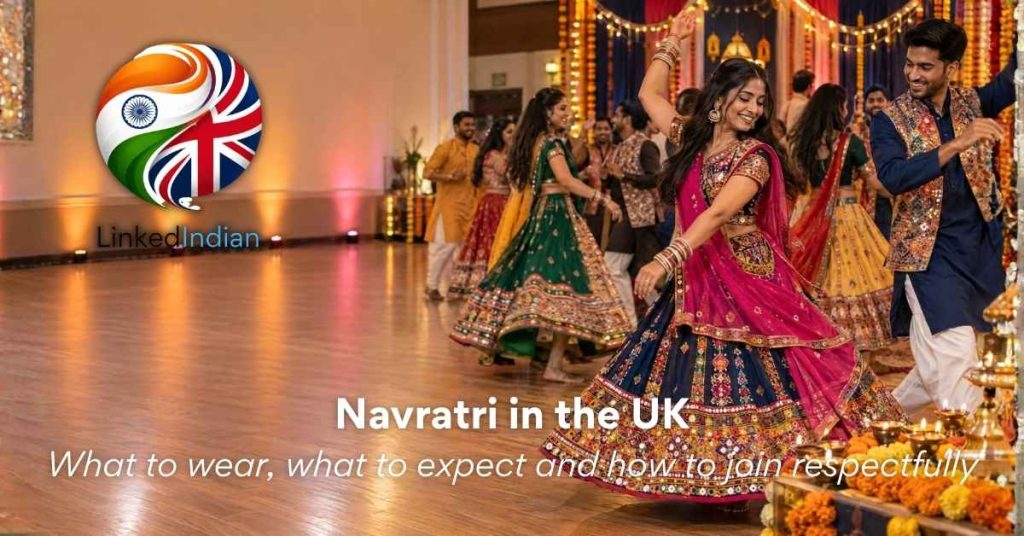
Navratri is under way, and communities across the UK are preparing for evenings of Garba, Dandiya, prayer, music, food and family gatherings.
If you are attending your first UK Garba night, trying to find an event near London, deciding what to wear or wondering what is expected of you, this guide will help you plan without guesswork.
Navratri is not experienced in exactly the same way by every Indian family. Customs vary by region, faith, language, family tradition and personal practice. Garba and Dandiya are particularly associated with Gujarati celebrations, while other communities may focus more on puja, fasting, devotional music or family observance.
The most useful approach is to treat this as a practical starting point, then follow the information provided by the organisers or your family.
Event information changes quickly. Check the organiser’s ticket page before travelling. Times, venues, ticket availability, dress guidance and event arrangements can change after publication.
When is Navratri in the UK in 2026?
For London, the location-specific Navratri calendar lists the first day, Ghatasthapana, on Sunday 11 October 2026. The nine-day observance then continues through the middle of October, with dates for the individual days and colours shown in the local calendar.
Because festival dates are based on lunar calculations and local timings, different calendars may present the final observances slightly differently. If a puja, fast or family ceremony matters to you, use the calendar followed by your household, temple or community organiser.
London Navratri 2026 dates at a glance
- Day 1: Sunday 11 October
- Day 2: Monday 12 October
- Day 3: Tuesday 13 October
- Day 4: Wednesday 14 October
- Day 5: Thursday 15 October
- Day 6: Friday 16 October
- Day 7: Saturday 17 October
- Day 8: Sunday 18 October
- Day 9: Monday 19 October
The London calendar lists the day-one colour as orange, followed by white, red, royal blue and yellow for the following days. Colour traditions can vary by region and organiser, so treat colour-of-the-day lists as a helpful guide rather than a universal rule.
Where can you find Garba and Dandiya events in London?
The most reliable place to find a current event is the organiser’s own ticket page. Event listings can sell out, move venue or change their start time, particularly when several events are taking place on the same weekend.
At the time of writing, Eventbrite’s London Navratri listings include events such as:
- Navratri 2026 at Gascoyne 2 Community Hall on Sunday 18 October;
- Sheri Garba with Helaro 2026 Navratri at JFS School on Monday 19 October;
- Navratri Garba in Kenton on Saturday 17 October;
- a nine-day Garba event around Kenton and Preston; and
- other Garba and Navratri events in locations including South Beddington, Hoxton and Barking.
You can check the current London Navratri and Garba listings on Eventbrite. The listing page includes dates, venues and ticket information, but always open the individual event page before making travel plans.
If you live outside London, search for your local Hindu, Gujarati, Jain or Indian community centre, temple, cultural association or event organiser. Leicester, Birmingham, Coventry, Manchester, Leeds and other cities have active South Asian communities, but events may be promoted through local networks rather than one national calendar.
What is the difference between Garba and Dandiya?
Garba is a circular folk dance traditionally performed around a lamp or an image representing divine energy. The movement is often rhythmic and communal, with dancers forming circles that move in time with the music.
Dandiya Raas is a dance traditionally performed with decorated sticks. Participants use the sticks in coordinated patterns, usually with a partner or within a larger group.
Modern UK events may combine Garba, Dandiya, Bollywood music, live performances, DJs and food. The format depends on the organiser. Some events are strongly devotional, while others are primarily community or cultural celebrations.
If you are attending for the first time, read the event description. It should tell you whether sticks are provided, whether the event is family-friendly and whether there are separate timings for prayer, dancing or food.
What should you wear to a UK Garba night?
There is no single correct outfit, but colourful Indian festive clothing is common.
Women and girls may choose a chaniya choli, lehenga, saree, anarkali suit or another comfortable festive outfit. Men and boys may wear a kediyu, kurta with trousers, waistcoat, sherwani-inspired outfit or smart Indian fusion clothing.
Comfort matters more than creating a perfect look. Garba can involve several hours of standing, walking and dancing, so choose:
- footwear that you can comfortably dance in;
- clothing that allows your arms and legs to move;
- secure jewellery that will not catch on other dancers;
- layers for travelling to and from the venue; and
- a small, secure bag for your phone and essentials.
If you are buying an outfit, check the event date and delivery promise before ordering. UK October evenings can be cool, and a beautiful outfit is less useful if you cannot move comfortably or need to carry a large coat around the dance floor.
For a first event, it is completely acceptable to wear a simpler outfit. You do not need to own a heavily embroidered chaniya choli or a full traditional wardrobe to participate respectfully.
What should a beginner expect at Garba?
A UK Garba night may feel energetic and crowded, but most people are there to enjoy the music and community rather than judge beginners.
When you arrive, expect some combination of ticket checking, a cloakroom or bag policy, food stalls, a DJ or live music, photographs and a dance floor. Larger events may have several thousand attendees, while local community gatherings may be much smaller and more relaxed.
If you are new:
- Watch the outer edge of the circle before joining.
- Start with the basic steps and follow the people beside you.
- Leave enough space for the dancers around you.
- Move in the direction of the circle rather than cutting across it.
- Ask someone nearby if you are unsure about the next pattern.
- Take a break when you need one and keep hydrated.
You do not need to learn every step before you attend. Many people learn by following the rhythm and the group.
Garba and Dandiya etiquette
Follow the organiser’s instructions
Venues may have rules about footwear, outside food, photography, sticks, alcohol, children, seating and when you can enter or leave the dance floor. These rules are practical and may vary from one event to another.
Be careful with Dandiya sticks
Keep your movements controlled and be aware of the people around you. Do not swing sticks above shoulder height in a crowded space, and stop if the area becomes too tight.
Do not treat religious elements as props
Some events include a lamp, puja or devotional programme. Observe quietly and follow the lead of people taking part. Ask before photographing sacred items or someone’s prayer.
Respect clothing and personal space
Festive clothes are often colourful and highly detailed, but they are not an invitation to touch someone’s outfit, jewellery or body. Ask before taking a photograph and respect a clear no.
Do not assume everyone follows the same practice
Some attendees may fast. Others may not. Some may be attending for worship, while others are there for dance, music and community. Avoid questioning someone’s food choices or suggesting that one family’s practice is the only authentic one.
Include newcomers
If you are attending with friends or relatives who are unfamiliar with Garba, explain the basic flow and help them join at the edge of the circle. A brief welcome can make a first event much more comfortable.
Navratri fasting and food in the UK
Fasting practices vary considerably. Some people avoid particular grains, pulses, onions or garlic. Some eat fruit, dairy or vrat-friendly foods. Others do not fast at all.
Do not assume that a dish is suitable simply because it is labelled “vegetarian”. If you are hosting, ask guests what they can eat and label food clearly. If you are attending a ticketed event, check whether food is included and whether the organiser has published ingredient or allergen information.
If you are fasting, plan ahead for a late-night event. Take water, understand the venue’s food policy and do not feel pressured to eat something that does not fit your observance.
If you are cooking for guests, use a separate preparation area where possible and be clear about ingredients. Dietary expectations can differ even within the same family.
How to attend respectfully if you are not Gujarati or Hindu
You do not need to belong to the community to attend a public cultural event, but you should understand that Navratri is more than a colourful party for many people.
Read the event description, dress neatly, follow the organiser’s instructions and ask a friend to explain anything you do not understand. If the event includes worship, give people space and avoid treating devotional moments as entertainment.
It is also fine to participate in the dancing without pretending to have knowledge you do not have. A respectful question is usually welcome. What matters is listening, observing and allowing the community to set the tone.
What should you take with you?
For a typical UK Garba night, consider taking:
- your ticket or digital booking confirmation;
- a phone with enough battery for travel and meeting friends;
- a small bag that complies with venue rules;
- water, unless the venue prohibits outside drinks;
- a light layer for the journey home;
- blister plasters if you are wearing new footwear; and
- a contact number for the person you are attending with.
If Dandiya sticks are not provided, check whether the organiser sells or permits them. Do not assume that you can bring your own sticks into every venue.
For London, the location-specific calendar lists the first day of Sharad Navratri as Sunday 11 October 2026. Local timings and family observances may vary, so check the calendar followed by your household or community.
Wear something festive and comfortable. A kurta, anarkali, lehenga, saree, chaniya choli or Indian fusion outfit can work, provided you can move comfortably and wear suitable footwear.
Yes. Most newcomers learn by watching the outer edge of the circle and following the basic steps. Go with someone who can explain the event format, or ask a nearby dancer politely for help.
Not always. Some organisers provide them, some sell them and some expect attendees to bring their own. Check the individual event listing before travelling.
No. Practices vary by region, religion, language, family and personal belief. Garba and Dandiya are particularly associated with Gujarati celebrations, but Navratri observance is broader than any one community’s format.
Eventbrite maintains a changing list of London Navratri and Garba events. You can check the current listings using the link provided in the article, then open the individual organiser page to confirm the venue, time and ticket status.
Navratri is an opportunity to celebrate devotion, movement, music and community in many different ways. Whether you attend one local Garba night, join nine evenings of dancing or mark the festival quietly at home, there is no need to perform someone else’s version of tradition. Choose the parts that are meaningful to you, take part respectfully and make room for other people’s practices too.