
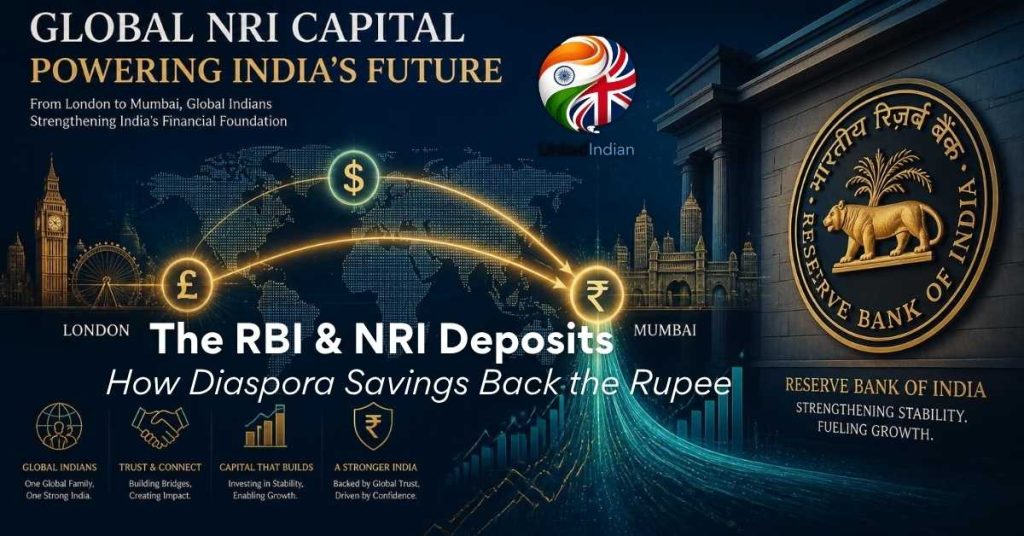
India’s latest outreach to overseas Indians was not a diaspora bond, a tax concession or a sentimental appeal. It was something more technical and, in some ways, more revealing: a foreign-exchange swap arranged by the Reserve Bank of India (RBI).
The result has been dramatic. Under a special USD-INR swap facility introduced on 8 June, authorised dealer banks reported $65.397bn in FCNR(B) deposits by 21 August. With overseas foreign-currency borrowings and external commercial borrowings included, reported inflows under the wider facility reached $72.848bn. The RBI has said the FCNR(B) portion will close on 31 August, earlier than initially envisaged.
Those numbers make the scheme important well beyond NRI banking. It is a case study in how India can use trust within its global community to buy time, liquidity and confidence when the rupee needs support. But it is also a reminder that foreign-currency funding is never costless. The central bank has not simply found free dollars. It has changed who bears a meaningful part of the currency risk.
The mechanism in plain English
FCNR(B), short for Foreign Currency Non-Resident (Bank), is a foreign-currency deposit product for eligible non-resident Indians. The deposit is held in foreign currency, so the depositor’s principal and interest are not converted into rupees at maturity. In the 2026 special window, banks mobilised fresh or renewed FCNR(B) deposits for terms from three to five years; Kotak Mahindra Bank’s explanation of the facility also notes a one-year lock-in for early withdrawal.
Normally, a bank that raises dollars but lends or invests in rupees must carefully hedge the mismatch. If the rupee weakens, buying back dollars later can become expensive. That hedge has a cost, and that cost limits the return a bank can offer to a dollar depositor.
The special facility changes this equation. The RBI provides a buy/sell foreign-exchange swap for the principal of eligible deposits. Its own FAQ makes two boundaries clear: the arrangement covers principal, not interest, and it is a plain foreign-exchange swap from the RBI’s side. The 2026 terms are described by banks as an at-par reversal, meaning that the second leg occurs at the same exchange rate as the first leg.
In practical terms, the RBI takes in dollars today and gives the bank rupees, with a commitment to reverse the principal transaction later. The participating bank is therefore protected from the exchange-rate movement on the principal during the swap term. It still must manage the interest it owes the depositor, credit risk and its own balance-sheet choices.
| Party | What it receives | What it gives or assumes | Why it matters |
| NRI depositor | A foreign-currency deposit and the bank’s quoted return | Dollar or other eligible foreign-currency funds, subject to deposit terms | The depositor avoids a forced rupee conversion at maturity. |
| Participating bank | Dollar funding, rupee liquidity and a principal hedge through the swap | A foreign-currency deposit liability and interest obligation | The hedge can make the deposit more attractive to raise and price. |
| RBI | Foreign currency now, plus a way to temper pressure in the FX market | A future obligation to reverse the principal swap | The facility can strengthen liquidity and confidence, but leaves a future balance-sheet exposure. |
This is why the phrase “subsidy to the diaspora” captures something real, but needs care. The RBI is not mailing a payment to every NRI depositor. Instead, it offers participating banks a facility that removes or reduces a cost that would normally be embedded in the pricing of a foreign-currency deposit. Some of that benefit can be passed on to customers in the form of better rates or more attractive terms. The immediate recipient of the swap is the bank; the ultimate beneficiary can be the depositor, the bank and the broader economy.
A familiar Indian playbook, updated
The 2026 facility has a clear predecessor. During the external-sector pressures of 2013, the RBI opened a swap window for fresh FCNR(B) deposits with a minimum maturity of three years and a one-year lock-in. That earlier facility also covered principal rather than interest, but charged banks a 3.5% swap cost compounded semi-annually for the duration.
The comparison is useful because it shows continuity in the policy logic. When international financial conditions become unfriendly, India has a relatively deep pool of overseas savers who understand the country, its banks and its long-term potential. A suitably designed deposit programme can turn that affinity into foreign-exchange liquidity faster than many conventional capital-market channels.
Yet 2026 is not simply 2013 repeated. The current window’s at-par structure is more generous to participating banks on principal exchange-rate risk than a fixed paid swap would be. That makes the programme more powerful as a mobilisation tool, while also making it more important to be precise about its public cost. The cost is not necessarily an immediate budgetary outlay. It is the economic value of the risk the RBI has agreed to hold, and it will only be fully visible as the swaps mature and are unwound.
Why the rupee benefits
Foreign-exchange markets are influenced by flows as much as by headlines. When banks receive a surge of dollar deposits and swap those dollars with the RBI, the system gains dollar liquidity and the central bank gains capacity to manage demand and supply in the currency market. That can reduce the risk of a self-reinforcing fall in the rupee, particularly when investors are wary or external funding conditions tighten.
The scale of the 2026 response is therefore notable. The $65.397bn reported in FCNR(B) inflows by 21 August came in little more than ten weeks from the facility’s launch. Such an inflow does not determine the exchange rate by itself, and the RBI has not presented it as a permanent solution to external imbalances. It can, however, change the market’s near-term arithmetic and signal that India retains access to willing foreign-currency funding.
That signal rests on more than one policy window. India’s diaspora already supports the country through remittances. The World Bank estimated that India would receive $129bn in remittances in 2024, the largest inflow among all recipient countries. Remittances are transfers, typically supporting families and household spending. FCNR(B) deposits are bank liabilities that must be repaid. Treating them as the same thing would obscure the policy trade-off, but both demonstrate the depth of India’s financial connection with people living abroad.
“The facility is a plain buy/sell foreign exchange swap from the RBI side covering only the principal amount of the deposits and not the interest component.”
Reserve Bank of India, FAQ on the 2026 facility
While foreign-currency deposits offer fixed holding returns, everyday family support continues to flow through remittance channels detailed in our Aspora vs. Remitly guide.
The important question: who carries the risk?
A successful deposit window can make a currency market calmer today while creating obligations for tomorrow. At maturity, banks must return the foreign currency to depositors and complete the reverse swap with the RBI. If many deposits mature together, the system can face a concentrated rollover or repayment challenge. The three-to-five-year tenure in the current programme spreads that moment out, but it does not remove it.
There is also a distributional question. The facility is available through banks and targeted at foreign-currency deposits from a particular constituency. It can be rational policy because the macroeconomic benefit is shared broadly: a more orderly rupee market, improved liquidity and potentially less disruptive policy tightening. Still, the benefit to diaspora depositors is real. Policymakers should be candid that they are using public balance-sheet capacity to obtain private foreign-currency funds at a moment of strategic need.
That candour matters because it makes the policy easier to assess fairly. Calling it a “giveaway” is too simplistic. Equally, calling it costless would be wrong. The best test is whether the facility has delivered foreign-exchange resilience at a lower and safer cost than the realistic alternatives, such as sharply higher domestic interest rates, more aggressive spot-market intervention, or a disorderly adjustment in the rupee.
What this means for overseas Indians
For NRI savers, the lesson is not that every FCNR(B) offer is automatically superior. A deposit decision should begin with the individual’s currency needs, tax residence, liquidity horizon, bank counterparty and the actual rate offered. The special facility is a macroeconomic measure, not personalised financial advice.
For the diaspora as a whole, however, the episode carries a more positive message. Overseas Indians are not viewed merely as a source of remittances or ceremonial connection. In moments of financial stress or uncertainty, their savings can be part of India’s economic resilience. That contribution deserves acknowledgement, along with a clear explanation of the terms on which it is sought.
The RBI’s window will close, and the debate will shift from mobilisation to management. The key questions will be how the funds were deployed, how smoothly the swaps are unwound, and whether the reserve cushion they created helped India navigate a more volatile global environment. The answer will determine whether this was an elegant temporary bridge or a costly way of postponing a harder adjustment.
For now, the scheme reveals a pragmatic bargain at the heart of India’s relationship with its global community: the diaspora supplies confidence and hard currency; the state supplies a measure of protection and trust. A more stable rupee may be the dividend. The future cost of that stability is the part that must be watched just as closely.
Editorial note
Disclaimer & Attribution: This article provides independent macroeconomic commentary informed by public reports from the Reserve Bank of India, World Bank data, and analysis from The Economist. It is intended for informational purposes only and does not constitute individual financial, investment, or tax advice.
References
[2] Kotak Mahindra Bank, RBI FCNR(B ) Swap Window 2026 Guide for NRIs, 19 June 2026
[3] Reserve Bank of India, Swap Facility for FCNR(B ) deposits, ECBs and OFCBs FAQ, June 2026
[4] Reserve Bank of India, Swap Window for attracting FCNR(B ) Dollar funds FAQ, 2013
[6] The Economist, How India’s central bank subsidised the diaspora, supplied source, 27 August 2026